Things to Do in Changchun From the Puppet Emperor's Palace to the Changchun Film Studio
Changchun preserves its strange capital history inside the halls of Puyi's Puppet Emperor's Palace and the soundstages of the old Soviet-built film studio, linked by the city's vintage tram line.
Things to Do in Changchun from the Puppet Emperor’S Palace to the Changchun Film Studio
You stand in the bedroom of the last emperor of China. The bed is narrow, the wallpaper faded, and the air in the Weihuanggong feels sealed in 1945. Puyi slept here, a prisoner in a palace built by his colonial handlers, surrounded by gardens designed to look like a European estate that never existed. This is the core experience of Changchun: the queasy juxtaposition of imperial fantasy and occupation. The question is what remains of the Manchukuo era to visit, and the answer concentrates on two sites connected by a tram line that still runs on tracks laid during that period.
The Puppet Emperor’S Palace the Strange Heart of Changchun
Arrival, Tickets And The Route That Saves Time
Book the general admission ticket, 80 CNY in high season (April 15 to October 15, 2025 rate set by the Jilin Provincial Development and Reform Commission) or 60 CNY in low season. Pay at the gate; third-party bundles add nothing. Arrive at 08:30 when the gate opens. High season closing is 17:00 with last entry half an hour before. Low season closing is 16:30. Set aside three hours. The site covers 137,000 square meters with 47,000 square meters of exhibition space, so the walking distance is real.
The Private Quarters First
The palace was completed in 1914 as a salt commissioner's compound and became Puyi's residence from 1932 to 1945. Skip the main ceremonial hall first. It is rebuilt and feels hollow. Go straight to the private quarters in the eastern courtyard. That narrow bed, the cramped study, the fake fireplace. Puyi lived here as the Puppet Emperor of Manchukuo, a colony dressed as a kingdom. The incongruity is deliberate. Step outside into the Western-style gardens, a manicured lawn with a fountain and rose beds that could be clipped from a Sussex manor. It is wrong here in the birch forests of northeast China, and that is exactly the point. The colonial planners wanted him to play a European monarch. The effect is sad, not grand.
The Essential Context
Spend twenty minutes in the exhibition hall documenting the colonization of northeast China, the biological warfare program, and the true function of the Manchukuo state. It is blunt and necessary. The palace without that context is just strange architecture. With it, the strangeness becomes history.
The Vintage No. 54 Tram Riding The Colonial Grid
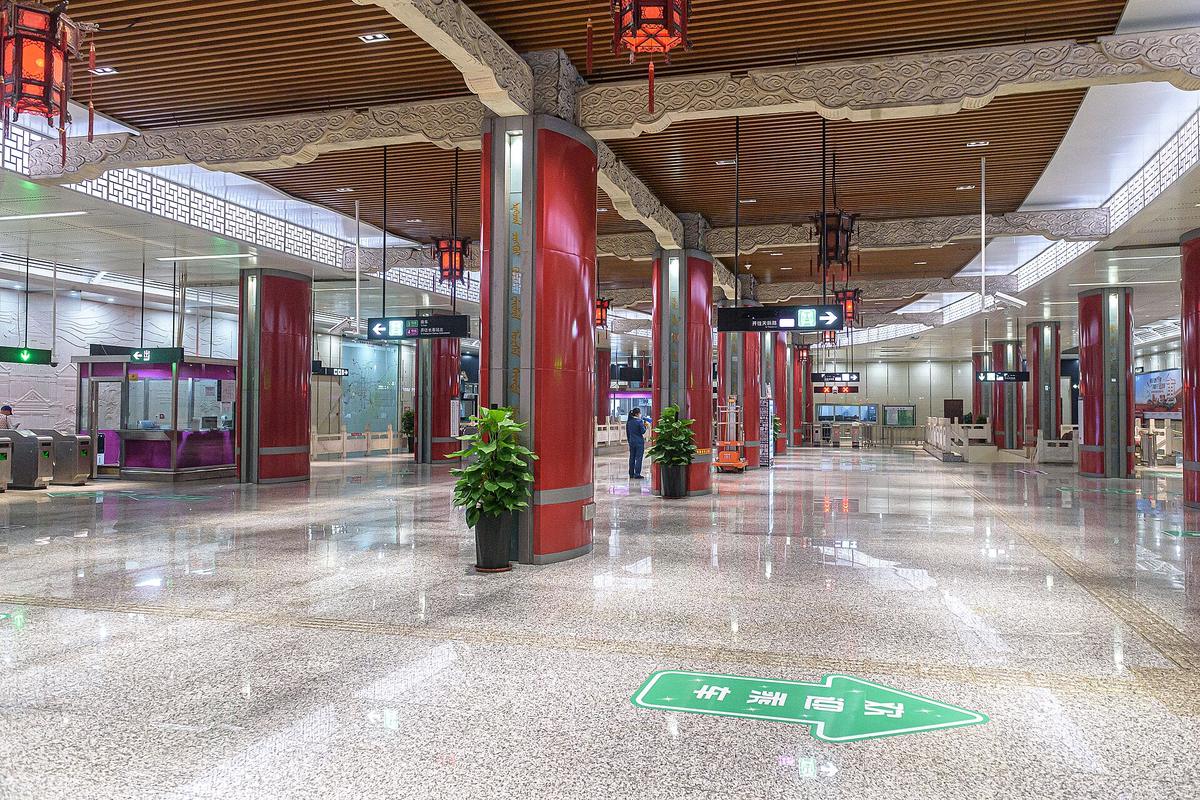
Exit the palace and walk five minutes to the tram stop on Guangfu Road. The No. 54 tram is original rolling stock from the 1940s, painted green and cream, running on the broad boulevards the Imperial Army laid out. Board it heading west. The ride costs 2 CNY and takes twenty minutes to reach the Changchun Film Studio stop. Sit on the left side for the best view of the plane trees and the low period buildings that still define central Changchun. The tram is not a tourist gimmick, it is the actual connection between the two eras this city is built on.
.jpg)
Changchun Film Studio Socialist Cinema in a Former Propaganda House
What You Are Actually Seeing
The Changchun Film Studio museum costs 90 CNY (2025 rate) and opens 09:00 to 16:30. This is not a working studio tour. It is a museum of the first major film studio of the People's Republic of China, founded in 1945, previously the Manchukuo Film Association, which made propaganda for the puppet state. That continuity, from occupation propaganda to PRC cinema, is the story the museum tells badly but the building tells well.
Walk the soundstages. They are vast, concrete, socialist-realist spaces built in the 1950s. The museum holds costumes, cameras, and set pieces from classics like The Legend of Tianyun Mountain and Five Golden Flowers. The real experience is the scale of the place. These were the production lines of national mythmaking. You can see the editing tables, the dubbing booths, and the original projection equipment. It feels like a factory because it was one. Skip the 4D theater, it adds 30 CNY and wastes time. Head instead to the outdoor prop lot, a collection of mock streets from Republican-era Shanghai and Manchukuo-era streetscapes. They are accurate and eerie, built for films about the era your afternoon at the palace just taught you about.
What To Skip And How To Finish The Day
Do not combine this day with the First Automobile Works museum. FAW was founded in 1953, rolled out its first truck in 1956, first car in 1958, and launched the Hongqi brand that same year. The FAW-Volkswagen joint venture started in 1991. It is a fine car museum, but it is a half-hour taxi ride south and opens a different conversation about industrial China. Save it for another day. The failure case here is timing. The museum closes at 16:30 and there is nothing to do in the immediate neighborhood after dark. If you stay until the last minute, you exit onto a wide avenue with no cafes and no taxis waiting. Leave by 15:30, walk back to the tram stop, and ride the No. 54 toward the center. Disembark at Nanhu Park instead. The park is 222 hectares with a 92 hectare lake, entry is free, hours are 06:00 to 21:00. It is a grid of paths through birch and pine, built over the old colonial water supply system. Walk the lake loop in forty minutes. This is Changchun's actual public space, not a set piece. That is where the day finishes better. If Changchun’s story belongs to the last emperor and Soviet cinema, Harbin’s belongs to the ice and the Russian quarter that survived him.
Winter Considerations and the Season You Should Avoid
Changchun winter runs November through March with daily mean temperatures below 0°C. The mean from December to February is -15°C to -10°C. The extreme low recorded is -36.5°C. Annual snowfall is 30 to 40 days. The Ice and Snow Festival runs late December to late February. If you come for the festival, the palace is still open but the gardens are buried in snow and the heating in the private quarters is inadequate. Your experience will be a cold one. If you are here only for the Palace and the Film Studio, come in May or September. The tram runs year round. The museum does not heat its outdoor prop lot. Plan accordingly.
_and_persimmon.jpg)
Getting to Changbaishan a Note on Routing
Changchun is a practical base for Changbaishan. The high-speed train to the North Slope takes 2 hours 10 minutes to 2 hours 40 minutes. The road option is 5 to 6 hours. The West Slope is 2 hours 30 minutes to 3 hours by high-speed train. That is a separate trip. Do not try to do the volcano and the palace in the same day. It does not work.
Common Questions
How much time do I need at the Puppet Emperor's Palace?
Three hours minimum. You need 90 minutes for the private quarters and gardens, 30 minutes for the exhibition hall on the colonization, and 30 minutes for the western courtyard. The site covers 137,000 square meters with 47,000 square meters of exhibit space.
Should I buy tickets in advance for either site?
No. Tickets for both sites are sold at the gate at a fixed price set by the Jilin Provincial Development and Reform Commission for the palace and the studio's own 2025 rates. No third party discounts exist. Buying online adds a service fee for no benefit.
Can I visit the Palace and the Film Studio in one morning?
No. The Palace opens at 08:30 and takes three hours. The Film Studio opens at 09:00 and takes two hours. You need seven hours total including the tram ride between them. Start at 08:30, finish by 15:30.
Is the tram worth the detour?
Yes. The No. 54 tram costs 2 CNY and runs on tracks laid during the occupation. It connects the Palace directly to the Film Studio in twenty minutes. It is the only transport that puts you inside the original city grid. Skip it only if you cannot walk to the stop.
Read next
-
 Provincial China Beyond Beijing Shanghai Guangzhou and Xi’an
Provincial China rewards slow travellers with compressed continents of culture, cuisine, and landscape far beyond the standard megacity circuit.
Provincial China Beyond Beijing Shanghai Guangzhou and Xi’an
Provincial China rewards slow travellers with compressed continents of culture, cuisine, and landscape far beyond the standard megacity circuit.
-
 Planning a Slow Travel Route Through Yunnan’s Lesser-Visited Villages
Plan a slower Yunnan journey through Dali, Shaxi, and Nuodeng, with realistic transport allowances, guesthouse advice, and respectful village visits.
Planning a Slow Travel Route Through Yunnan’s Lesser-Visited Villages
Plan a slower Yunnan journey through Dali, Shaxi, and Nuodeng, with realistic transport allowances, guesthouse advice, and respectful village visits.
-
 From Guiyang to Congjiang — A Week in Guizhou by Bus and on Foot
Independent travel from Guiyang to Congjiang in Guizhou: buses, minibuses, journey times, seasonal road conditions, and village guesthouses explained.
From Guiyang to Congjiang — A Week in Guizhou by Bus and on Foot
Independent travel from Guiyang to Congjiang in Guizhou: buses, minibuses, journey times, seasonal road conditions, and village guesthouses explained.