The China That Exists Past the Four Cities Everyone Names First
Provincial China rewards slow travellers with compressed continents of culture, cuisine, and landscape far beyond the standard megacity circuit.
- Flag
-

- ISO code
- CN
- Population
- 1,410,000,000
- Currency
- CNY
- Timezone
- Asia/Shanghai
- Dial code
- +86
The China That Exists Past the Four Cities Everyone Names First
The mistake almost every first timer makes is believing that Beijing, Shanghai, Xi'an, and Guangzhou define China. They do not. Those four cities are the gateway, the handshake, the tourist board poster. The real country lives in the provinces, and it lives differently in each one. The country spans 9,597,000 square kilometres, an east-west stretch of roughly 5,200 kilometres, a north-south span of about 5,500 kilometres. That is continental scale. And yet most travellers cram themselves into four urban hubs and call it a China trip. The result is a kind of travel fatigue: you have seen the Forbidden City, the Bund, the Terracotta Warriors, the Canton Tower, and somewhere around the third identical airport terminal you realise you have not actually met China. Provincial travel is the correction.
Yunnan is the best argument for abandoning the circuit. It functions like a compressed continent. The province averages about 2,000 metres in elevation but its range is ridiculous, from 76 metres in the Honghe river valley to 6,740 metres at Kawagebo peak. Sweat in the tropical humidity of Xishuangbanna one morning and shiver under a Himalayan snow peak in Shangri-La the same week. Twenty five of China's 56 officially recognised ethnic groups live here, roughly 33 percent of the population by the 2020 census. That is not a statistic. It means entirely separate languages, festivals, cuisines, and building traditions within a few hours of each other. Five UNESCO World Heritage sites sit inside the provincial border: Lijiang Old Town, the Three Parallel Rivers, South China Karst, the Chengjiang Fossil Site, and the Cultural Landscape of the Honghe Hani Rice Terraces. No other province stacks that density.
What Provincial Travel Costs You
Provincial travel demands more time, far more patience with infrastructure gaps, and a willingness to accept that the famous ancient towns have commercialised hard. Lijiang's Dayan district is a UNESCO maze of cobblestone lanes. It is also thick with identical tourist shops and photo studios. The charm is there, but you have to walk past three dozen shops selling the same embroidered pouch to find it. Fly into Lijiang Sanyi Airport. Take the airport bus to the old town, a 40 to 60 minute ride costing 20 to 30 yuan. Then accept that from here the distances are genuinely brutal. A 200 kilometre journey on a map routinely takes five or six hours thanks to mountain switchbacks and speed limits. Do not try to cover Kunming, Dali, Lijiang, and Shangri-La in a single week. That common mistake produces four near identical old towns seen through a bus window and zero time at altitude to acclimatise or explore beyond the souvenir stalls. Book a minimum of 10 days for Yunnan alone. Any less and you burn your trip on internal transit without experiencing a single region properly.


- Total Area: 9,597,000 km²
- East, West Distance: Approx. 5,200 km
- North, South Distance: Approx. 5,500 km
- Time Zones: 1 official (Beijing Time, UTC+8); de facto solar span approx. 4 hours
- High-Speed Rail Network (2024): 47,000 km
- Beijing, Kunming HSR Travel Time: 10 h 30 min (fastest)
- Yunnan Average Elevation: Approx. 2,000 m
- Yunnan Recognised Ethnic Groups: 25 (out of 56 nationally)
- Yunnan Minority Population (2020 Census): Approx. 33%
- Yunnan UNESCO World Heritage Sites: 5 (Lijiang Old Town, Three Parallel Rivers, South China Karst, Chengjiang Fossil Site, Cultural Landscape of Honghe Hani Rice Terraces)
Why Yunnan Works and Where it Frays
Yunnan rewards the traveller who trades speed for texture. The province has clear best fits and clear mismatches. It suits backpackers extending north from the Southeast Asia circuit, serious hikers and cyclists chasing high altitude endurance, tea specialists willing to go deep on pu'er sourcing, photographers hunting rice terraces and minority market scenes, and slow travellers who value cultural texture over ticking off sights. Do not come here for luxury resort polish. Do not bring a tight schedule that cannot absorb multi hour mountain transfers. Do not expect untouched authenticity without commercial tourist infrastructure. The infrastructure exists. It just runs alongside the souvenir stalls.
The Gateway and the Gauntlet
Kunming Changshui Airport is your main international gateway. Metro Line 6 takes you to the city centre in 25 minutes for 5 to 8 yuan. Kunming itself is the practical transit hub, a spring like climate city where you orient yourself before heading into the province. Dali Old Town sits beneath the Cangshan mountain range, its backpacker cafes and Erhai Lake cycling circuit forming a natural first stop. The lake's west bank holds quiet villages and boutique guesthouses with bicycle lanes. Skip Dali's Three Pagodas as a paid attraction. They are iconic Buddhist landmarks, but best seen from a distance, as a photograph, not an entrance fee. Lijiang's Shuhe district offers a quieter alternative to Dayan, still commercialised but with more breathing room. Shangri-La, formerly Zhongdian, sits on the high Tibetan plateau at 3,200 metres. Altitude sickness hits hard here. Do not land at Shangri-La Diqing Airport and immediately attempt a hike. The taxi from the airport into town costs a fixed 40 to 50 yuan and takes 20 minutes. Use that first day to walk slowly, drink water, and let your body adjust.
Beyond the Old Towns
The real texture sits outside these hubs. Shaxi preserves a horse caravan town on the old Tea Horse Road, its Sideng Square intact with an ancient market stage and cobbled lanes. Reach Shaxi from Lijiang by road in about two hours. Friday market day is worth timing your visit to coincide with. Xishuangbanna, centred on Jinghong, offers tropical Dai culture, sticky heat, and a Southeast Asian feel that belongs to a different country. The Xishuangbanna Tropical Botanical Garden in Menglun houses a vast collection of rare plants. Yuanyang's Hani rice terraces function as multi coloured water mirrors during winter, visible from viewpoints accessible by local van from the Xinjie town in about 30 minutes. Sunrise at Duoyishu is the shot. Tiger Leaping Gorge demands two days for the high trail, sheer canyon walls and a physical effort that filters out the day trippers. Book everything in advance during peak season, especially October, when clear skies and golden photography light draw crowds. Avoid Chinese National Day from 1 to 7 October and Labour Day from 1 to 5 May entirely. Attractions hit capacity. Accommodation triples in price. Road travel becomes a parking lot. July and August bring monsoon rains and landslide risks in the south. Winter is your friend for the terraces. Summer is not.
Sichuan, Gansu, Fujian: Three More Arguments
Yunnan is the lead example, but the pattern repeats across other provinces. Sichuan, whose capital is Chengdu, holds Jiuzhaigou Valley, a UNESCO World Heritage site inscribed in 1992, and the Sichuan Giant Panda Sanctuaries, inscribed in 2006. Chengdu serves as the logical base, and the 144 hour visa free transit policy available there makes it viable for travellers with existing China itineraries who want a deep dive into one province. The food alone justifies the detour. Sichuan cuisine does not translate well outside the province. The numb heat of real mapo tofu or a hot pot at street level in Chengdu is a different category from the export versions. Gansu, one of the far west provincial level divisions along with Xinjiang, Tibet, and Qinghai, links the Chinese heartland to the Silk Road corridor. Dunhuang and Jiayuguan sit here, the Mogao Caves and the western end of the Great Wall. The minimum altitude in the far west drops to minus 154 metres at the Turpan Depression. The highest point is Mount Everest summit at 8,848.86 metres on the Tibet Nepal border. That is the range you are dealing with. Fujian, on the southeast coast, offers a different texture entirely: coastal villages, tulou earth buildings, and a tea culture that rivals Yunnan's. The typhoon season runs from July to October, so plan for autumn or spring.
Each of these provinces demands the same trade offs. More time on the road. More reliance on shared minivans and private drivers for the last mile into villages. More patience with squat toilets and no soap in rural bus stations. English is near zero outside high end hotels. Pointing at photos and running a translation app are mandatory. Stone paved old town streets become lethal in rain and impossible for wheeled suitcases. A Chinese SIM card with a local data plan is non-negotiable. You need it for Didi, for maps, for translation. Google, WhatsApp, Instagram, and Gmail are blocked without a VPN. Install and test one before you arrive in China. Guesthouse Wi Fi in mountain areas is slow and unreliable. Do not rely on it. Carry a spare battery pack for your phone. You will use it every day.
How to Eat Provincial
Food is the fastest route into provincial texture, and each region demands a different order. In Yunnan, start with cross bridge rice noodles, the theatrical DIY soup where you slide quail egg and raw meat slices into boiling broth at your table. Order er kuai in Dali, chewy rice cakes grilled or stir fried. Eat pu'er tea hot pot chicken, poultry simmered with aged tea leaves, somewhere near the tea mountains. Dai style lemongrass grilled fish comes wrapped in banana leaf, river fish punched up with herbs. Rushan is Dali's fried goat milk fan drizzled with rose sugar, a sweet finish. Lijiang baba is layered flatbread, sweet or savoury. Jianshui grilled tofu is a pungent street snack dipped in chilli powder. None of these dishes travel well. Eat them where they are made.

_05.jpg)
Who This Country is for and Who Should Stay on the Circuit
Provincial China suits the traveller who already knows that four cities cannot hold a country of 9.6 million square kilometres. It suits the person who will trade a five star hotel for a guesthouse with slow Wi Fi if the view from the window is a rice terrace at dawn. It suits the hiker who wants Tiger Leaping Gorge as a two day commitment, not an Instagram thumbnail. It suits the eater who orders the thing they cannot identify. It does not suit the traveller with 10 days and 12 cities on the itinerary. It does not suit the person who needs English spoken at every counter. It does not suit the luxury resort seeker who expects seamless polish. The first timer who sticks to Beijing, Xi'an, Shanghai, and Guilin is not wrong. That is the trip that most people should take first. The recommendation from the Chinese tourism system itself lists those four cities for the initial visit. Yunnan, Sichuan, Gansu, and Fujian are listed as third trip regions. But if you are reading this, you already know which kind of traveller you are. Book Yunnan for a minimum of 10 days. Pack a translation app and a VPN. Plan for 200 km to take five hours. Blister your feet on cobblestones in the rain. Eat something you cannot name. That is the China that exists past the four cities everyone names first.
Regions & cities in China
Common Questions
Is 10 days enough for Yunnan?
10 days is the minimum. Any less and you spend your trip on internal transit. 200 km routinely takes five to six hours on mountain roads. Budget for that.
Which airport should I fly into for Yunnan?
Fly into Kunming Changshui Airport for the widest international connections and the Metro Line 6 link to the city centre. Lijiang, Dali, and Shangri-La airports serve regional flights from Chinese hubs only.
Can I pay with foreign cards in provincial China?
No. Payment is overwhelmingly WeChat Pay or Alipay. Foreign cards fail on most local transport apps. Link a Visa or Mastercard to Alipay or WeChat Pay before departure. Cash is legal tender but many urban vendors are cashless.
Do I need a VPN?
Yes. Google, WhatsApp, Instagram, and Gmail are blocked inside China. Install and test a VPN before you arrive. Guesthouse Wi Fi in mountain areas is often unreliable, so a Chinese SIM card with data is also non-negotiable.
When is the worst time to visit Yunnan?
Chinese National Day from 1 to 7 October and Labour Day from 1 to 5 May. Attractions hit capacity. Accommodation triples. Roads become parking lots. Avoid both windows completely.
How do I handle altitude sickness?
Shangri-La sits at 3,200 metres. Jade Dragon Snow Mountain reaches 4,500 metres. Do not fly into Shangri-La and attempt a strenuous activity the same day. Walk slowly, drink water, and allow at least one acclimatisation day before hiking.
Is the visa-free transit policy useful for provincial travel?
Yes. The 144 hour visa free transit policy is available at Kunming and Chengdu among other cities, covering 54 nationalities on the 2024 list published by the National Immigration Administration. This allows a focused provincial trip without a full tourist visa for eligible travellers.
Read next
-
 Yunnan
 demands at least 10 days and a ruthless edit of your wishlist. This guide explains how to route a trip through China's most varied province without burning your holiday on mountain switchbacks.
Yunnan
Yunnan demands at least 10 days and a ruthless edit of your wishlist. This guide explains how to route a trip through China's most varied province without burning your holiday on mountain switchbacks.
-
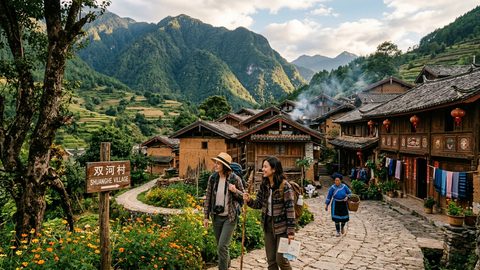 Planning a Slow Travel Route Through Yunnan’s Lesser-Visited Villages
Plan a slower Yunnan journey through Dali, Shaxi, and Nuodeng, with realistic transport allowances, guesthouse advice, and respectful village visits.
Planning a Slow Travel Route Through Yunnan’s Lesser-Visited Villages
Plan a slower Yunnan journey through Dali, Shaxi, and Nuodeng, with realistic transport allowances, guesthouse advice, and respectful village visits.
-
 From Guiyang to Congjiang — A Week in Guizhou by Bus and on Foot
Independent travel from Guiyang to Congjiang in Guizhou: buses, minibuses, journey times, seasonal road conditions, and village guesthouses explained.
From Guiyang to Congjiang — A Week in Guizhou by Bus and on Foot
Independent travel from Guiyang to Congjiang in Guizhou: buses, minibuses, journey times, seasonal road conditions, and village guesthouses explained.