Songzanlin Monastery Is Shangri-La’s Little Potala Palace. Here’s How to Visit It Properly.
Songzanlin Monastery is Shangri-La's Tibetan Buddhist heart, often called the Little Potala Palace. Know the photography rules, opening hours, and how to behave inside.


Arrive Before 08:30 and You Have the Courtyard to Yourself
Songzanlin Monastery opens at 07:30. The first shuttle bus from the visitor centre departs by 07:45. Morning prayer runs from roughly 06:00 to 07:30. You cannot enter the main hall during prayer, but you can observe from the rear. That is worth doing once.
What matters more is the 45-minute window between 08:00 and 08:45, when the tour groups from Lijiang have not yet arrived. Walk the 146 steps up to the main assembly hall with the sun low behind you, lighting the gilded roofs. The only sounds are wind and chanting. By 09:00 the first busloads arrive and the atmosphere shifts from contemplative to queued. The choice is simple: be in the first shuttle or spend your visit stepping around selfie sticks.
- Name: Songzanlin Monastery (Ganden Sumtseling Monastery)
- Chinese Name: 松赞林寺 (Sōngzànlín Sì)
- Founded: 1679 by the Fifth Dalai Lama
- Altitude: ~3,300 m
- Ticket Price (2026): ¥90, includes shuttle bus from visitor centre
- Visit Duration: 1.5, 2.5 hours
- Photography Inside Halls: Prohibited
- Closest Airport: Shangri-La Diqing (DIG), 20 min taxi fixed ¥40, 50
What You Are Looking at and Why it Matters
Songzanlin was built in 1679 as a deliberate architectural echo of Lhasa's Potala Palace. The resemblance is not accidental. The Fifth Dalai Lama ordered its construction to extend Gelugpa Buddhist influence into the eastern Tibetan borderlands. For its size alone, the monastery commands attention. Zhacang, the main assembly hall, rises five stories and can hold 1,600 monks. Jikang, the protector deity hall, sits beside it. Around them, more than 200 monks' quarters climb the hillside in a terraced formation that from a distance looks like a white and ochre fortress.
Do not mistake the scale for completeness. Between 1966 and 1976 the monastery was almost entirely destroyed. Rebuilding began in 1981 and continues. Of the 17th century original, only partial stone foundations and some lower walls remain inside the newer structures. That does not make the site inauthentic. It makes it a living monastery, not a mausoleum. Roughly 700 monks live, study and pray here today. You are a visitor in a working religious complex, not a tourist at a museum.
Zhacang And Jikang: What To Look For
Walk clockwise through both halls. That is the first rule and the one most visitors break. Enter Zhacang from the eastern door. Inside, the dark interior is lit by butter lamps and thin shafts of high window light. The walls are covered in thangka paintings and the central statue is Maitreya, the future Buddha. Monks sit on long benches in rows, their chanting low and percussive. Do not stop in the doorway. Do not point at the statues. Do not raise your voice. Remove your hat before entering. Shoulders and knees must be covered. These are not suggestions. Guards will tell you to leave if you ignore them.
Jikang is smaller and darker. It houses the protector deities, and the atmosphere is heavier. Photography is banned in both halls. The ban is absolute. Cameras and phones must stay in your pocket. The courtyards and exterior are fair game. Use them.
The Thin Air Changes Your Pace
Shangri-La sits at 3,300 m. You feel it the moment you step off the plane at Diqing Airport. The 146 steps from the main courtyard to Zhacang are not physically demanding at sea level. At this altitude they will leave you breathless. Plan for that. Walk slowly. Take a breath between every ten steps. Carry water. The monastery grounds are not large, but the staircases, the sloping pathways between the monks' quarters, and the walk back down to the shuttle stop will take longer than your legs expect.
The ticket costs ¥90 and includes the shuttle bus from the visitor centre to the monastery entrance. The bus ride takes five minutes. You cannot walk it. The visitor centre is roughly 2 km from the monastery gate and the road has no pedestrian access. Do not buy a ticket from a third party outside the centre. They are scams. Buy at the official counter inside.
When The Light Works For You
October delivers the clearest skies and the best golden-hour light on the monastery's western facade. That is the peak season for photography. Chinese National Day from 1 to 7 October and Labour Day from 1 to 5 May are the two windows to avoid entirely. Attractions hit capacity, accommodation triples in price and road travel becomes a parking lot. Summer from July to August brings rain and landslides on the roads from Lijiang. Mid-morning from 08:30 to 10:30 gives you direct light on the main hall. Late afternoon from 16:00 to 17:30 lights up the monks' quarters from the opposite side. Match your visit to the wall you want to shoot.


Getting to the Monastery
From Shangri-La town, take a taxi. The fixed rate from the old town to the visitor centre is ¥20 to ¥30. The ride takes about 10 minutes. Local bus number 3 runs from the city centre to the monastery, but it does not enter the visitor centre compound. You get dropped at the main road and walk the rest. The taxi is worth the extra ¥15.
Do not attempt to walk from the town. It is 5 km uphill and the thin air will punish you before you reach the ticket booth. Do not hire a bicycle for the same reason. The monastery is not a strenuous visit, but the altitude makes every physical choice slower. Respect that.
Leave your tripod at the hotel. It is not banned, but the interior photography ban makes it useless indoors and the courtyards are crowded enough by 09:30 that a tripod becomes a liability. Leave your drone at home entirely. The monastery is in a restricted flight zone and the local police enforce it.
Bring a water bottle, a hat for sun protection, and a jacket. The temperature at 3,300 m drops sharply once the sun passes behind the hills, even in October. Do not bring large backpacks inside the halls. Do not bring food into the prayer spaces. Do not bring any expectation that you can move through the site in under an hour. The fastest visit worth doing is 90 minutes. The average visitor who stops to look properly spends two hours.
What To Skip
Skip the audio tour. The numbered stops are static and the recording is dated. Skip the souvenir stalls at the visitor centre. The same items are sold in Shangri-La town at half the price. Skip the temple-side cafe. The coffee is instant and the view is better from the hillside above the monks' quarters.
Common Questions
Can I visit Songzanlin Monastery without a tour?
Yes. The ticket includes a shuttle bus from the visitor centre to the monastery entrance. No guide is required. Buy the general admission ticket at the official counter, not a third party bundle. The ¥90 fee covers everything you need.
What happens if I take a photo inside the halls?
A guard will tell you to delete it. If you argue, you will be escorted out. The photography ban inside Zhacang and Jikang is enforced without exception. Keep your phone in your pocket until you are back in the courtyard.
Is Songzanlin worth visiting if I have been to Potala Palace in Lhasa?
Yes, for a different reason. Potala Palace is a museum now. Songzanlin is an active monastery with monks in residence. The architecture echoes Potala but the atmosphere is not the same. If you have already seen Lhasa, treat this as the living version of a building you saw preserved.
How do I handle the altitude at 3,300 m?
Acclimatise for one full day in Shangri-La before visiting. Drink water, skip alcohol, avoid caffeine. The 146 steps to the main hall will wind you. Walk them slowly. If you feel dizzy or nauseous, sit down and descend. The visitor centre has oxygen canisters for ¥20 if needed.
Can I attend morning prayer?
Yes, but you observe from the rear of the hall only. Enter quietly before 06:00. Do not walk between the seated monks. Do not use flash or record audio. Stay for 10 to 15 minutes and leave before the session ends at 07:30 to avoid disrupting the exit.
Read next
-

 Where to Stay in Shangri-La at 3200 Metres Without Ruining Your Acclimatisation
Shangri-La accommodation is a choice between Dukezong old town atmosphere at full altitude and the newer county town with lower elevation and oxygen-equipped rooms—your lungs will have a preference.
Where to Stay in Shangri-La at 3200 Metres Without Ruining Your Acclimatisation
Shangri-La accommodation is a choice between Dukezong old town atmosphere at full altitude and the newer county town with lower elevation and oxygen-equipped rooms—your lungs will have a preference.
-
 Things to Do in Shangri-La From Songzanlin Monastery to Pudacuo Alpine Lakes
Songzanlin Monastery's gilded halls, Pudacuo's alpine lakes at 3,500 metres, and Dukezong's rebuilt lanes with a giant prayer wheel—Shangri-La rewards those who acclimatise before exploring.
Things to Do in Shangri-La From Songzanlin Monastery to Pudacuo Alpine Lakes
Songzanlin Monastery's gilded halls, Pudacuo's alpine lakes at 3,500 metres, and Dukezong's rebuilt lanes with a giant prayer wheel—Shangri-La rewards those who acclimatise before exploring.
-
 Best Time to Visit Shangri-La for Alpine Flowers and Monastery Festivals
Shangri-La's high plateau only truly opens from June to October—alpine flowers peak in early summer, October skies are crystalline, and winter freezes guesthouses shut.
Best Time to Visit Shangri-La for Alpine Flowers and Monastery Festivals
Shangri-La's high plateau only truly opens from June to October—alpine flowers peak in early summer, October skies are crystalline, and winter freezes guesthouses shut.
-
 Getting Around Shangri-La and Reaching Tiger Leaping Gorge From the Plateau
Shangri-La has no high-speed rail—Diqing Airport taxis, shared minivans to Tiger Leaping Gorge, and private drivers are how you move across the high plateau at 3,200 metres.
Getting Around Shangri-La and Reaching Tiger Leaping Gorge From the Plateau
Shangri-La has no high-speed rail—Diqing Airport taxis, shared minivans to Tiger Leaping Gorge, and private drivers are how you move across the high plateau at 3,200 metres.
-
 Provincial China Beyond Beijing Shanghai Guangzhou and Xi’an
Provincial China rewards slow travellers with compressed continents of culture, cuisine, and landscape far beyond the standard megacity circuit.
Provincial China Beyond Beijing Shanghai Guangzhou and Xi’an
Provincial China rewards slow travellers with compressed continents of culture, cuisine, and landscape far beyond the standard megacity circuit.
-
 Planning a Slow Travel Route Through Yunnan’s Lesser-Visited Villages
Plan a slower Yunnan journey through Dali, Shaxi, and Nuodeng, with realistic transport allowances, guesthouse advice, and respectful village visits.
Planning a Slow Travel Route Through Yunnan’s Lesser-Visited Villages
Plan a slower Yunnan journey through Dali, Shaxi, and Nuodeng, with realistic transport allowances, guesthouse advice, and respectful village visits.
-
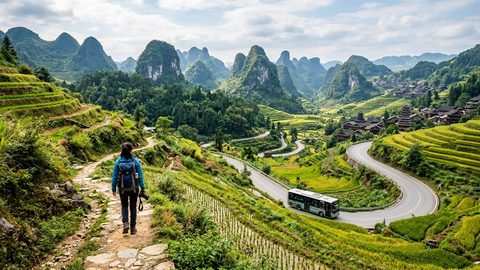 From Guiyang to Congjiang — A Week in Guizhou by Bus and on Foot
Independent travel from Guiyang to Congjiang in Guizhou: buses, minibuses, journey times, seasonal road conditions, and village guesthouses explained.
From Guiyang to Congjiang — A Week in Guizhou by Bus and on Foot
Independent travel from Guiyang to Congjiang in Guizhou: buses, minibuses, journey times, seasonal road conditions, and village guesthouses explained.