What Is Worth Carrying Home From Yunnan's Markets and Workshops
Yunnan's best souvenirs are Pu'er tea from the source, Zhoucheng indigo batik, and Jianshui purple pottery—but much of what glitters in Lijiang's silver shops is not local.
Ten Yunnan Souvenirs Worth the Luggage Space—and How to Pack Them
Most travellers walk into a Lijiang or Dali souvenir shop and buy a compressed pu'er tea cake stamped "15 years aged" for CNY 50. That cake is low-grade leaf from a factory in Menghai, wrapped in a fake vintage wrapper. The printed date means nothing. Here are the ten items genuinely made in Yunnan by traceable craftspeople, separated from the mass-produced replicas that fill the old town stalls—plus packing instructions that survive airport security.
Pu’er Tea: Worth the Deep Dive, Easy to Fake
Pu'er tea comes in two families. Raw tea, called sheng cha, naturally ferments over years: astringent and bright when young, smooth and complex when aged. Ripe tea, called shou cha, goes through a wet-pile fermentation for 45 to 60 days: earthy and mellow from the start. Both are pressed into shapes. Bingcha round cakes. Tuocha bowls. Zhuancha bricks. Fangcha squares. Common weights are 100 g, 200 g, 357 g, and 400 g.
Where to Buy Tea You Can Trust
Where you buy matters more than what you pay. In the Xishuangbanna tea mountains around Jinghong, buy directly from producers who show you the drying racks. In Kunming, the official tea markets such as Tangzijia allow modest bargaining: expect 10 to 20% off the first quote. A fair price for a 357 g daily ripe cake is CNY 80 to 300. A daily raw cake of the same size runs CNY 150 to 600. Aged raw cakes start at CNY 1,000 and go past CNY 50,000 depending on mountain origin, storage conditions, and documented age.
Skip the Old Town Tea Shops
In Lijiang Dayan and Dali old towns, the cheap aged cakes are not the age or origin claimed. The majority are mislabelled. A 2015 wrapper on a 2024 cake is common. Skip the old town souvenir shops entirely. Buy from a tea market or a farm stand where the person selling you the cake can tell you which mountain the leaves came from.


Three Crafts You Can Trust, One You Cannot
Zhoucheng Tie-Dye: Genuinely Handmade
Forty minutes by minibus from Dali old town, Zhoucheng village produces batik from indigo vats. You see the dye pits, the pattern-tying benches, the finished cloth drying in the sun. Sheets run CNY 30 to 100 depending on size and complexity. A single workshop session costs around CNY 80 and gives you a small cloth you made yourself. This is not a factory replica. It is a village craft with a traceable address.
Dongba Paper: A Living Script Tradition
Paper made from Wikstroemia canescens bark, the same material used for Dongba scripture manuscripts in Lijiang. Sheets range from A4 to A3, priced CNY 5 to 20 per sheet depending on thickness. Buy from workshops in Baisha village, 20 minutes by bus from Lijiang, where you can watch the bark being pounded into pulp. Tourist shops in Dayan sell it too, but the prices double and the quality drops.
Naxi Textiles: Stripes and Wool
Hand-spun wool and cotton striped aprons, capes, and bags from Lijiang and Baisha. Prices start around CNY 100 for a simple bag and go to CNY 400 for a full cape. Look for shops that spin the wool on site; the weaving looms are a reliable sign. Machine-made imitations from Zhejiang sell for CNY 40 in Dayan. They delaminate after two washes.
Bai Silver: Assume It Is Fake Until Proven Real
Dali and its surrounding villages are the traditional centre for Bai silver: bracelets, neck rings, hairpins, belt pendants, bowls. Shops claim S990 purity, meaning 99% silver. The gram price runs CNY 8 to 25 depending on design and shop location. The failure case: a nickel-copper alloy plated and stamped with a silver mark. If the shop cannot show you a small bare patch on the inside of the piece, or if the price per gram is below CNY 8, walk away. A simple bangle from a workshop where you see the smith at work costs around CNY 120 for 10 grams. The same bangle in a tourist arcade costs CNY 90 and is not silver.
| Type | Harvest Season | 2024 Price Per Kg | Packing Rule |
|---|---|---|---|
| Matsutake | June to September | CNY 400 to 2,000 | Vacuum-sealed; loose declined by many destination countries |
| Porcini | June to September | CNY 150 to 600 | Vacuum-sealed; declared at customs as dried plant product |
| Morel | June to September | CNY 500 to 2,500 | Vacuum-sealed; some species restricted in Japan and Australia |
| Chanterelle | June to September | CNY 100 to 400 | Vacuum-sealed; acceptable in most markets if packaged |


How to Get Tea Cakes, Pottery, and Mushrooms Through Airport Security
Tea Cakes
Unwrap the compressed cakes and pack them in your checked luggage. X-ray machines see them as dense organic blocks; they attract no attention. Do not carry loose leaf tea in your carry-on. Customs at Kunming Changshui occasionally open bags with loose leaf and ask for an inspection. Vacuum-sealed commercial packages pass without issue. For international flights, declare the tea as dried plant product on the arrival form. The EU, US, and Australia allow commercially packaged tea. Japan requires quarantine inspection for loose leaf.
Pottery and Ceramics
Wrap each piece in clothing, not bubble wrap, and place it in the centre of your checked bag. Yunnan airport baggage handlers are not gentle. Breakage happens on 1 in 15 checked bags containing ceramics. If the piece is larger than 30 cm, buy a cardboard box at the market for CNY 5 and pack it with crumpled newspaper. Do not ship it unboxed.
Dried Mushrooms
Commercial vacuum packs are safe in checked luggage. The EU, US, and Australia accept them if they are declared and commercially packaged. Fresh or loose mushrooms are restricted by most destination countries. Do not bring them. Dried matsutake in a vacuum pack labelled with the producer and harvest year is fine. A bag of loose morels from a market stall will be confiscated. The harvest season is June to September, so if you are buying in October, the stock is from the previous summer. Check the year on the pack.
Antiques and Old Items
Any item made before 1911 requires a cultural relic export permit from the National Cultural Heritage Administration. Items from 1911 to 1949 are restricted and need appraisal and a permit. Do not buy anything that looks old without documentation. The seller will not warn you. If you try to take it through security, it will be seized.
Five Questions About Buying Yunnan Souvenirs
Can I bargain for tea at a Kunming market?
Yes, modestly. Expect 10 to 20% off the first quote. Much more than that and you are being offered a different cake than the one you asked about.
How do I know if a silver bracelet is real?
Ask the seller to scratch a small area inside the bracelet with a key. If the underlying metal is the same colour as the surface, it is likely silver. If it is reddish or grey, it is a nickel-copper alloy. Shop prices below CNY 8 per gram are almost certainly fake.
Can I bring dried mushrooms into the US?
Yes, if they are commercially vacuum-sealed and declared on your customs form. The same rule applies to Australia. Japan requires quarantine inspection and some species are restricted.
What is the one souvenir I should skip entirely?
Cheap aged pu'er cakes from Lijiang and Dali old towns. The wrapper date is not reliable and the leaf inside is low-grade. Spend the money on a fresh cake from a Kunming tea market instead.
How much time do I need to visit Zhoucheng?
Half a day. The minibus from Dali takes 40 minutes. Spend two hours at the workshops, eat lunch in the village, and be back in Dali by mid-afternoon.
Read next
-

 Yunnan Hotels Chains Courtyards and the Foreigner Registration Rule
Hotels in Yunnan range from international chains to courtyard guesthouses, but the foreigner registration rule determines where you can actually sleep—here is what to book.
Yunnan Hotels Chains Courtyards and the Foreigner Registration Rule
Hotels in Yunnan range from international chains to courtyard guesthouses, but the foreigner registration rule determines where you can actually sleep—here is what to book.
-
 Where to Stay in Yunnan Town by Town Base Guide
Where to stay in Yunnan, from Kunming to Shangri-La: neighbourhood-by-neighbourhood advice on old town courtyards, Erhai lake villages, and altitude-conscious bases.
Where to Stay in Yunnan Town by Town Base Guide
Where to stay in Yunnan, from Kunming to Shangri-La: neighbourhood-by-neighbourhood advice on old town courtyards, Erhai lake villages, and altitude-conscious bases.
-
 Flying Into Yunnan Kunming Lijiang Dali and Shangri-La Airports Compared
Choosing between Kunming, Lijiang, Dali, and Shangri-La airports shapes your entire Yunnan route—here's how each gateway affects transit time, altitude, and cost.
Flying Into Yunnan Kunming Lijiang Dali and Shangri-La Airports Compared
Choosing between Kunming, Lijiang, Dali, and Shangri-La airports shapes your entire Yunnan route—here's how each gateway affects transit time, altitude, and cost.
-
 What Yunnan Is For Mountains Old Towns and Minority Culture
Yunnan is for high-altitude treks, living old towns like Shaxi, minority markets, winter rice terraces at Yuanyang, and going deep on Pu'er tea at the source.
What Yunnan Is For Mountains Old Towns and Minority Culture
Yunnan is for high-altitude treks, living old towns like Shaxi, minority markets, winter rice terraces at Yuanyang, and going deep on Pu'er tea at the source.
-
 Yunnan Weather Seasons and the Best Time to Visit Without the Crowds
Yunnan spans tropical lowlands and Himalayan peaks, so the best time to visit depends entirely on which region you're targeting and whether you can stomach the October crowds.
Yunnan Weather Seasons and the Best Time to Visit Without the Crowds
Yunnan spans tropical lowlands and Himalayan peaks, so the best time to visit depends entirely on which region you're targeting and whether you can stomach the October crowds.
-
 Getting Around Yunnan Rail Bus and the Mountain Road Reality
Getting around Yunnan means high-speed rail between Kunming, Dali, and Lijiang, then long-distance buses and shared minivans into the mountains—and 200 km takes 5 hours.
Getting Around Yunnan Rail Bus and the Mountain Road Reality
Getting around Yunnan means high-speed rail between Kunming, Dali, and Lijiang, then long-distance buses and shared minivans into the mountains—and 200 km takes 5 hours.
-
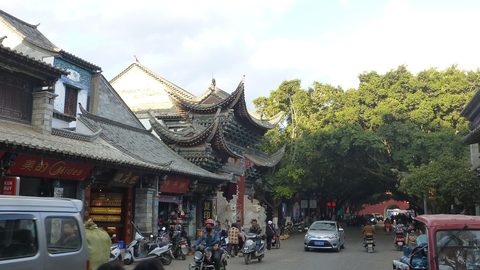 Jianshui
 has a Ming dynasty seventeen-arch bridge, one of China's largest Confucian temples, and tofu grilled on street corners—and almost every Yunnan itinerary skips it.
Jianshui
Jianshui has a Ming dynasty seventeen-arch bridge, one of China's largest Confucian temples, and tofu grilled on street corners—and almost every Yunnan itinerary skips it.
-
 Gejiu
The Yuanyang rice terraces only become the mirror-like spectacle of photographs from November to March—here is how to time the water season and hit the right viewpoints at sunrise and sunset.
Gejiu
The Yuanyang rice terraces only become the mirror-like spectacle of photographs from November to March—here is how to time the water season and hit the right viewpoints at sunrise and sunset.
-
 Baoshan
 unlocks Yunnan's wild western edge: the Gaoligong mountains, Tengchong's volcanic hot springs, and the ghosts of the Burma Road. A frontier for second-time visitors.
Baoshan
Baoshan unlocks Yunnan's wild western edge: the Gaoligong mountains, Tengchong's volcanic hot springs, and the ghosts of the Burma Road. A frontier for second-time visitors.