Yunnan Hiking Beyond Tiger Leaping Gorge The Shaxi to Shigu Trail
A practical guide to Yunnan Hiking Beyond Tiger Leaping Gorge The Shaxi to Shigu Trail.


Why this trail deserves your attention
Yunnan hiking has a crowding problem. Tiger Leaping Gorge draws a steady stream of trekkers, and its guesthouses fill with travellers comparing notes on the same switchbacks. If you want a multi-day walk that trades the gorge's bottleneck for solitude, the old caravan corridor between Shaxi and Shigu delivers something rare: a route where the history beneath your boots feels as present as the landscape around you.
This is not a single waymarked trail. It is a patchwork of village paths, cobbled Tea Horse Road segments, and quiet mountain roads linking two of Yunnan's most distinctive towns. You will not find a continuous pedestrian track from door to door. What you will find are days spent walking through pine forest and Bai villages, past grottoes carved when the Nanzhao kingdom ruled this corner of China, and along a river bend so sharp it looks drawn on a map with a calligraphy brush.
Shaxi and the caravan road that shaped it
Shaxi was never a backwater. For over a thousand years it operated as a strategic midway staging depot on the Tea Horse Road, the mule-caravan network that funnelled Yunnan tea north into Tibet. Its Sideng Market Square was one of the most important caravanserai markets on the entire Yunnan section. Today the town is widely regarded as the most authentic and best-preserved historic market town in the province, restored in cooperation with a Swiss organisation to faithfully replicate the original fabric.
The trails radiating from Shaxi are not museum pieces. They are the same cobbled paths the caravans used, climbing through pine forest toward the Shibaoshan massif. Research describes these routes as having "almost nobody on them." The highest point reaches approximately 2,600 metres, placing the walking firmly in the easy-to-moderate range for anyone with basic fitness.
Two ways to walk Shaxi to Shibaoshan
The Shibaoshan Forest Sanctuary sits east of Shaxi, and two documented routes connect the old town to its grottoes. The shorter option begins at the Sideng Historic Core, crosses the Yujin Bridge, and climbs roughly 8.5 kilometres to the sanctuary with an elevation gain of about 320 metres. Plan on four to five and a half hours of walking.
A longer alternative starts from Shaxi Ancient Town and passes through Shadengqing Village before reaching the Shizhongshan Grottoes. This route covers about 12 kilometres, with an elevation range from 2,120 metres to 2,660 metres and a total ascent of approximately 530 metres. It is rated moderate difficulty. Both routes reward the effort with the Shizhongshan Grottoes, a complex of 17 caves whose carvings were created over roughly 320 years during the Nanzhao and Dali kingdoms. The site was designated a First Batch National Key Cultural Relic Protection Unit in 1961.
Entrance fees and shuttle bus charges for the Shibaoshan Scenic Area are not fixed in the research. Reported figures vary, so confirm the current cost with the Dali Shibao Mountain official scenic area or the Jianchuan County Tourism Bureau before setting out. Shaxi Ancient Town itself is free to enter as of recent years, but this status should be verified through the Jianchuan County Tourism Bureau or the Shaxi Ancient Town Tourism Service Centre.
Shigu and the First Bend of the Yangtze
Shigu Town sits at roughly 1,850 metres above sea level, a relief for anyone coming from higher altitudes around Shangri-La. The risk of altitude sickness here is relatively low for most visitors. Its defining feature is the First Bend of the Yangtze, where the Jinsha River executes a dramatic V-shaped turn of approximately 140 degrees before swinging northeast. The town takes its name from a stone drum monument, but the river bend is the reason to linger.
Shigu is not a hiking hub in the way Shaxi is. Accommodation consists mainly of family-run guesthouses, rural inns, and small boutique homestays. There are no internationally rated hotels in town. This is a place to rest, eat simply, and watch the river change colour as the light shifts.
Connecting Shaxi and Shigu overland
There is no continuous dedicated pedestrian trail linking Shigu to Shaxi. The overland route follows mountain roads and village paths. Cyclists have documented the distance from Shigu to Jianchuan as approximately 60 kilometres, with Jianchuan to Shaxi adding roughly 38 kilometres. Walkers should treat this as a multi-day rural ramble rather than a single defined trek. You will need to piece together segments using local roads, ask directions in villages, and accept that some sections will be on asphalt.
This is the tradeoff. Tiger Leaping Gorge gives you a clear path, guesthouses at predictable intervals, and a social experience. The Shaxi-Shigu corridor gives you the opposite: logistical ambiguity, near-total solitude, and the sense that you are moving through a landscape that has not been repackaged for visitors. Neither is objectively better. The choice depends on whether you value infrastructure or independence.
Planning around the seasons
The best hiking windows for the Shaxi area are late September to early November, which offers the clearest weather, stable conditions, and harvest activity in the valleys, and April to May, a greener but slightly less reliable second window. Summer brings rain that can turn village paths slick. Winter is cold at elevation but passable if you are equipped for it.
If you are arriving via Lijiang, bus services to Shigu Town are reported to run from Lijiang Passenger Station. Schedules cited in various sources should be confirmed directly with the station before departure. Do not assume frequency or timing without checking.
Sources and verification
- walkingchina.com — Research source checked for this guide
- roamchinatravel.com — Research source checked for this guide
- cyclefiesta.com — Research source checked for this guide
- yunnanexploration.com — Research source checked for this guide
- yunnanexploration.com — Research source checked for this guide
- yunnanexploration.com — Research source checked for this guide
Read next
-

 Yunnan Hotels Chains Courtyards and the Foreigner Registration Rule
Hotels in Yunnan range from international chains to courtyard guesthouses, but the foreigner registration rule determines where you can actually sleep—here is what to book.
-
 Where to Stay in Yunnan Town by Town Base Guide
Where to stay in Yunnan, from Kunming to Shangri-La: neighbourhood-by-neighbourhood advice on old town courtyards, Erhai lake villages, and altitude-conscious bases.
-
 Flying Into Yunnan Kunming Lijiang Dali and Shangri-La Airports Compared
Choosing between Kunming, Lijiang, Dali, and Shangri-La airports shapes your entire Yunnan route—here's how each gateway affects transit time, altitude, and cost.
-
 What Yunnan Is For Mountains Old Towns and Minority Culture
Yunnan is for high-altitude treks, living old towns like Shaxi, minority markets, winter rice terraces at Yuanyang, and going deep on Pu'er tea at the source.
-
 Yunnan Weather Seasons and the Best Time to Visit Without the Crowds
Yunnan spans tropical lowlands and Himalayan peaks, so the best time to visit depends entirely on which region you're targeting and whether you can stomach the October crowds.
-
 Getting Around Yunnan Rail Bus and the Mountain Road Reality
Getting around Yunnan means high-speed rail between Kunming, Dali, and Lijiang, then long-distance buses and shared minivans into the mountains—and 200 km takes 5 hours.
-
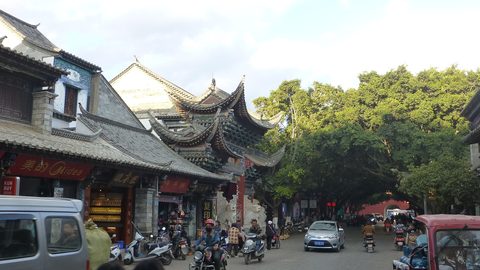 Jianshui
 has a Ming dynasty seventeen-arch bridge, one of China's largest Confucian temples, and tofu grilled on street corners—and almost every Yunnan itinerary skips it.
-
 Gejiu
The Yuanyang rice terraces only become the mirror-like spectacle of photographs from November to March—here is how to time the water season and hit the right viewpoints at sunrise and sunset.
-
 Baoshan
 unlocks Yunnan's wild western edge: the Gaoligong mountains, Tengchong's volcanic hot springs, and the ghosts of the Burma Road. A frontier for second-time visitors.